
 RoutrGet Routr
A simple flag football route tree
Use this route tree to name eight common shapes. The diagrams show a receiver starting to the right of the center: in and post break toward the middle, while out and corner break toward the sideline. Reverse the directions for a receiver on the other side. These are teaching sketches, not fixed depths or a universal numbering system.
Start at the dot and follow the arrow. A hitch turns back; a drag stays shallow across the field. A slant breaks in early, while an in turns across after a vertical stem. An out turns toward the sideline. A post angles toward the middle, a corner angles toward the outside, and a go continues upfield. Route names and depths can vary by playbook, so agree on a landmark with your players. NFL FLAG’s routes guide gives another set of examples.
Give each route a landmark
Teach a receiver where to start, where to make the first break and where the route finishes. Use yards from the line of scrimmage for depth. Describe the direction separately, so a player knows the difference between running farther downfield and moving across the field.
Keep the same names in practice, on diagrams and on your wristbands. A flat, hitch and dig ask for different movements. Walk the shape first, then add a pass. Once the receiver can run the route consistently, add a defender and let the quarterback learn the throwing window.
Hitch and stick create a quick target
A hitch climbs a short distance and turns back toward the quarterback. In Trips Stick, Y runs to 5 yards, faces the quarterback and sits in the open window. That hitch is the stick read in the play. The quarterback throws it when the flat defender widens with X.
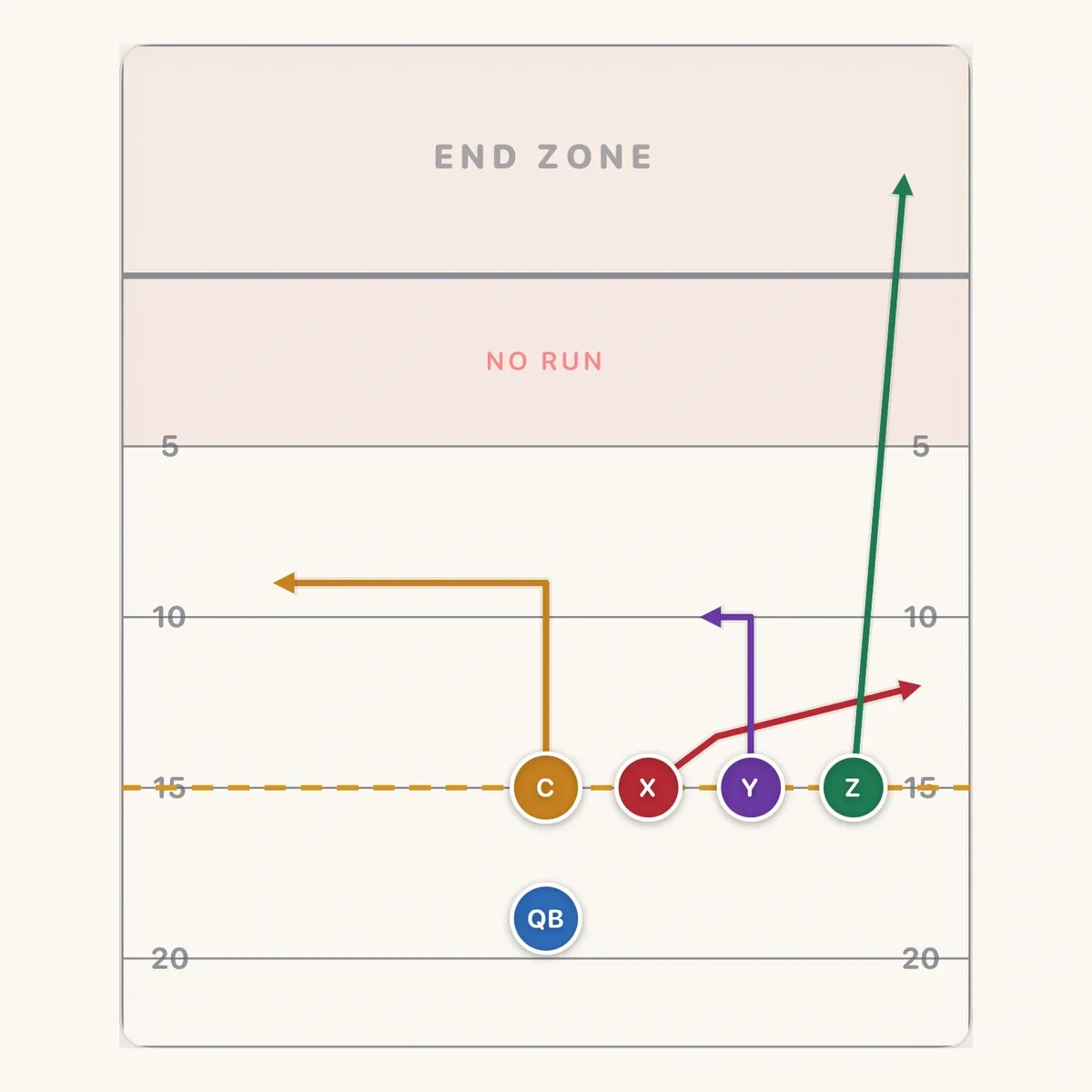
Keep the turn controlled. A receiver still spinning as the pass arrives is harder to hit than one showing the quarterback a clear target. In Dagger, C’s hitch reaches 4 yards and comes back to 3.5, giving the quarterback a shorter checkdown below the deep routes.
Flat and out work toward the sideline
A flat widens early and stays shallow. X in Trips Stick starts widening at 1.5 yards and finishes near 3 yards downfield. The route stretches the defender outside while Y sits inside. Keep X moving so the two targets stay apart.
An out has a deeper vertical stem before turning toward the sideline. Y in Sideline Drive climbs to 6 yards, then breaks outside. Z turns outside at 10 on the other side. Mark those depths and leave enough space to catch before the boundary.
In and dig cross at a steady depth
An in route turns toward the middle after a vertical stem. A deeper in is often called a dig. In Levels, Y breaks in at 5 yards while X breaks in at 10. The two depths make the middle defender choose which receiver to cover.
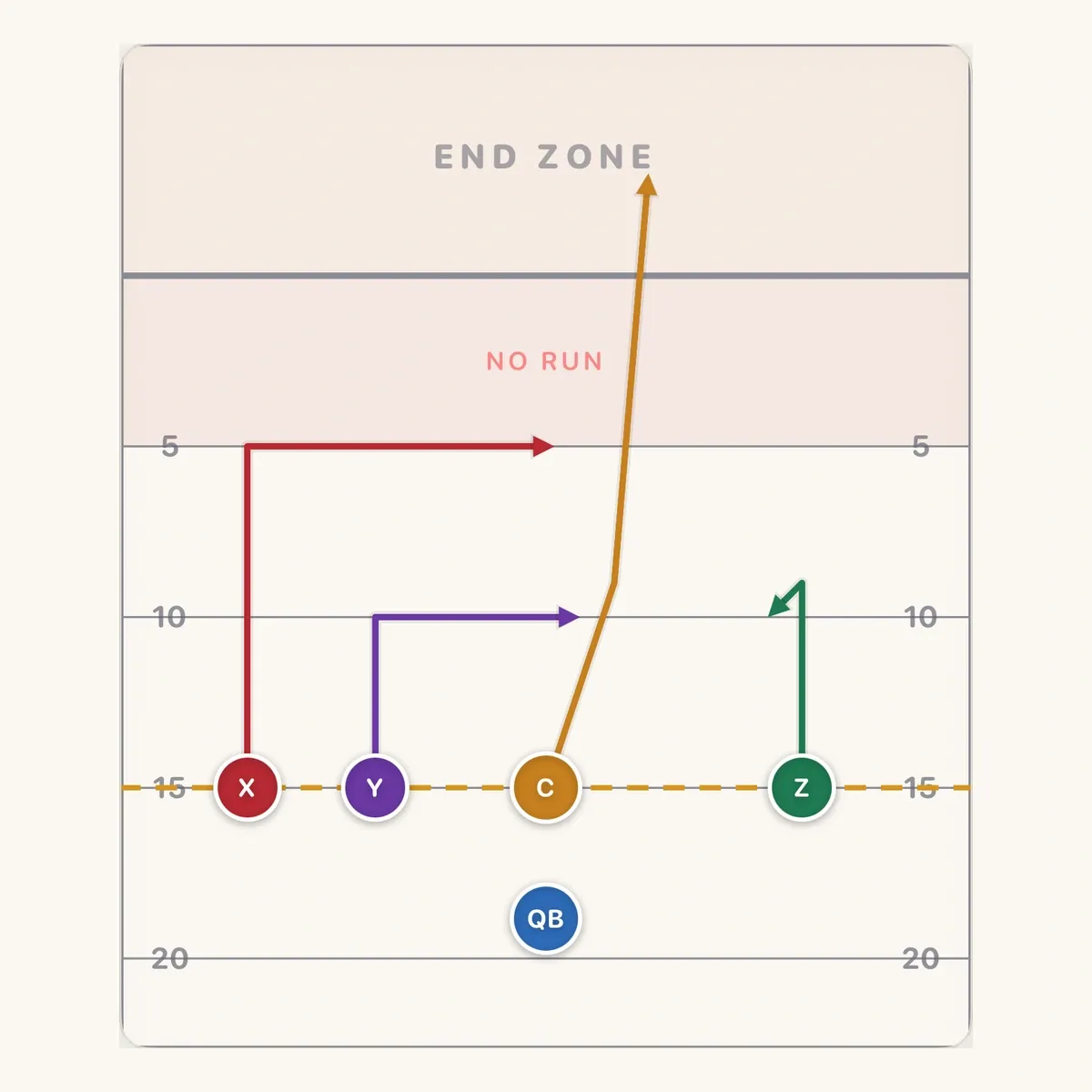
Coach the receiver to make a clear turn and hold that depth across the field. Drifting upfield changes the window the quarterback expects. Dagger uses the same inside-breaking idea with X selling vertical before turning flat at 14 yards.
Drag and cross keep receivers moving
A drag travels across the field at a shallow depth. In Mesh Drive, X crosses at 4 yards and Z at 6. The quarterback leads whichever receiver separates from the defender. Keep the two routes apart and run through the crossing point without blocking.
A deep cross gains more ground while moving across. In Y-Cross, Y starts the crossing movement at 6 yards, travels through 10 and finishes near 13. Teach the climb between those points so the route does not flatten into a shallow drag.
Go, seam, fade and corner stretch the field
A go continues vertically. X in Y-Cross runs toward 20 yards on the left. A seam works through an inside vertical lane. Y in Dagger runs the seam toward 20, stretching the deep coverage above X’s dig.
A fade keeps outside width while climbing. Y in Slot Fade Switch releases outside Z through 2.5 yards and continues toward 7.5. A corner breaks out and deeper after a stem. Y in Smash Return climbs to 5, then breaks toward 10 near the back corner.
Teach the outside catch with the sideline visible. The receiver needs room to complete the pass in bounds. Your quarterback places the ball into that space instead of asking the receiver to chase it beyond the boundary.
Curl, comeback and pivot change the receiver’s direction
A curl returns toward the quarterback after climbing downfield. Z in Dagger reaches 10 yards and comes back to 8.5. A comeback returns toward the sideline as well: X in Sideline Drive reaches 12 and comes back outside to 10.
A pivot sells one direction and turns back the other way. In Center Pivot, C takes three hard steps toward trips, reaches 3 yards downfield and returns toward the empty side near 3.5. Keep the plant sharp so the quarterback can throw as C turns.
Build the routes into a practice
Start with one receiver and cones at the break and finish. Walk the route, run it, then add a pass. Use the same landmark until the receiver can find it without slowing down to look for a cone.
Put two routes together next. Use the hitch and flat from Trips Stick or the two in routes from Levels. Add the defender who decides the throw and let the quarterback read that movement. Finish with the full play while keeping the same route depths and first decision.